Never have I ever read a better account of the absolute chaos that was the first 40 days of the pandemic. Written by Roopa Farooki, a writer and a junior doctor in the NHS, ‘Everything is True’ is an absolutely gripping narration of the real struggles faced by the frontline healthcare community in UK during the first wave of the Covid-19 pandemic, the various ways in which they were human and yet were expected to be humane 24×7 through every rota and every call, how even though March 2020 was the start of a new normal, the griefs of February 2020 were carried forward and co-existed during the loneliness of the lockdowns, and the toll that treating patients displaying myriad symptoms amid the fear of coronavirus took on many medical professionals. It is more than just a one-time read, and I feel it would be a perfect book for forthcoming book club discussions that end up getting scheduled online during the (possibly upcoming) fourth wave.
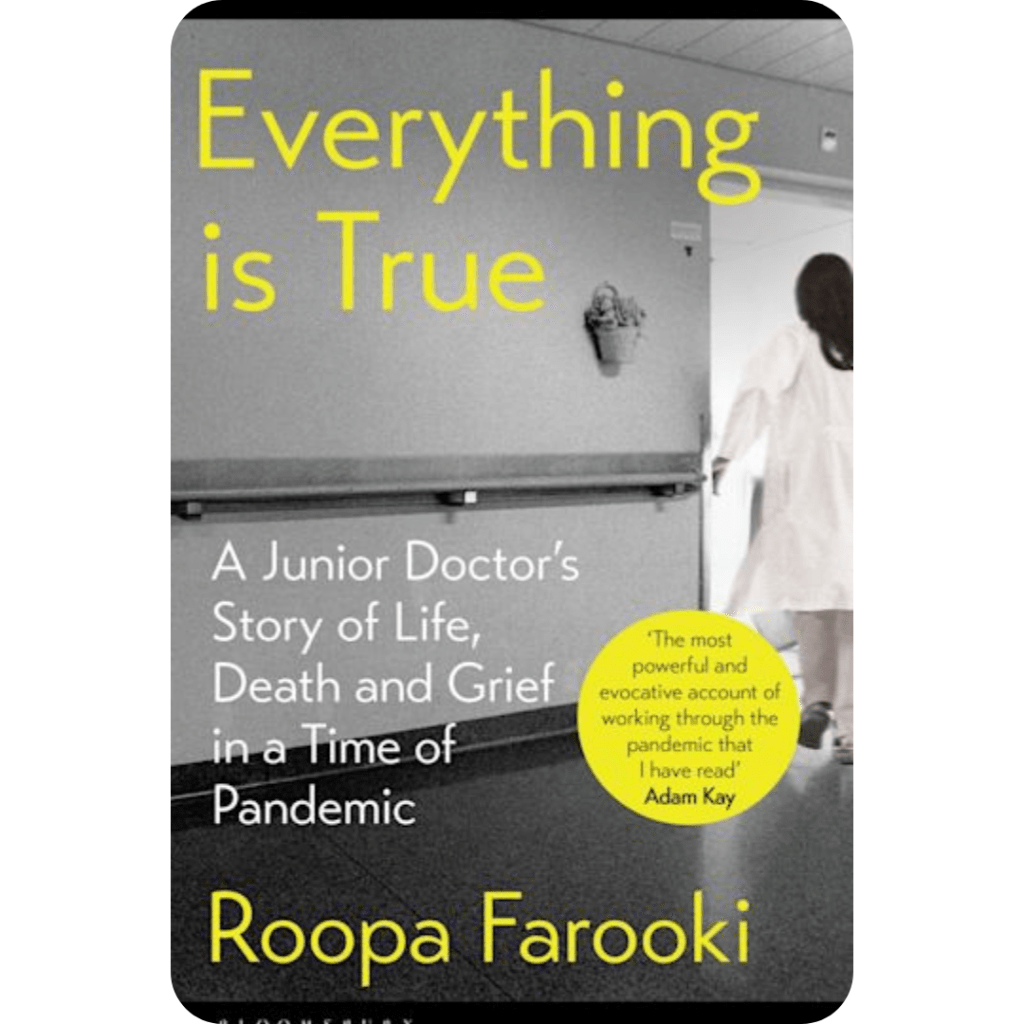
The prologue of the book starts with Roopa talking about her complex relationship with her sister, Kiron, and the whole maelstrom of emotions that took over her life when it was clear that Kiron would be around only for one more Christmas. The vignette-ish way of introducing the reader to her sister and the nature of the complexities in their interactions somehow don’t end up giving a one-dimensional view of this aspect of the author’s life. Which is only a foreshadowing of the brilliant way Roopa writes further.
Post her sister’s demise, even before the flowers on her table started withering away, Covid struck. Gradual descriptions of the initial lax attitude of people and authorities, watching from afar how the rest of the world plunged into disaster and yet heading out for after-office-hours parties, the minute details of how the world started adapting to this new normal: through daily tracking of death counts and age-wise mortality ratios, by getting pizza delivered home through no-contact mode, how patients who were suffering from diseases other than Covid couldn’t get access to the right treatment as planned, the gnawing hesitancy of entering a hospital even if you’re bleeding to death. Every sentence seemed like it was flowing directly from our collective memories.
Roopa focuses only on the first 40 days of the pandemic, aligning with the meaning of the root word of quarantine: a period of forty days of isolation to prevent the spread of a contagious disease.
I finished reading this book in two sittings over the same weekend. Short paragraphs written in a stream of consciousness style by replacing “I” with “you” had a tri-fold impact on my reading experience:
1. Roopa scraped together small slots of time in between caring for her four children, grieving for the loss of her sister to cancer a few weeks before the pandemic, and working as a junior doctor in the Accident & Emergency (A&E) department in her hospital to note down her daily thoughts, incidents that happened at work and these efforts are demonstrated through the length of the paragraphs.
2. Reading the book gets relatively easier as there are no heavy paragraphs spread across the pages. The reader can take some time to pause and reflect to empathise with the heavy content surrounding death, personal grief amid a large-scale tragedy, the helplessness of not being able to cure a disease completely yet doing your best to ease patients through their pain and the stories of overworked, tired, exhausted medical staff.
3. I had not yet come across a book which employed this style of using “you” as a pronoun in the place of “I” when the story is clearly written from a first-person point of view. I do write this way as well when I try to convey personal emotions which are complex to me. It felt good to know that a celebrated author also chose this method of writing, and seeing it in print was a validating experience.
I don’t think the author intends for this book to be a hopeful one, and so if you’re someone who doesn’t do well with such intense books, I wouldn’t question your decision of giving it a wide berth. However, if you’re a reader like me who wants to know more about the different forms of suffering that people endure, and the heartbreaking beauty of determination and living for something that’s bigger than just you, do read ‘Everything is True’ by Roopa Farooki.

 Mithila Menezes
Leave a comment