
I’ve always wanted to attend a masterclass in writing, or even go for a writer’s retreat. Procrastination gets the better of me every time I find an ad for such events. However, when Bloomsbury offered me an opportunity to read and review a book on Russian literature written by George Saunders who offers the reader free entry into his university lectures for approximately a week (a story a day), I couldn’t say no. Though I did end up procrastinating while reading and reviewing this book (I took almost a month to finish it), it was a thoroughly enjoyable experience.
I haven’t read much of Russian literature before. My experience of reading Crime and Punishment by Fyodor Dostoyevksy, or, to be precise, my experience of abandoning Crime and Punishment halfway multiple times made me hesitant to pick up books by other Russian authors. I’m glad that reading a set of seven short stories by authors like Anton Chekhov, Ivan Turgenev, Leo Tolstoy and Nikolai Gogol has got me curious again about Russian literature.
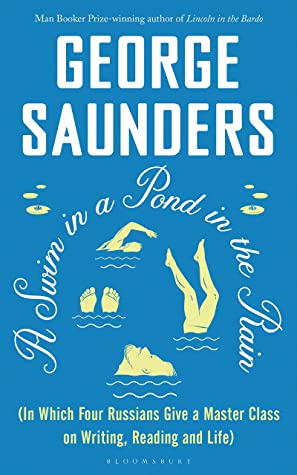
The title “A Swim in a Pond in the Rain” is derived from Saunders’ favourite story called Gooseberries, which is written by Anton Chekhov. I would urge you to read the story and Saunders’ explanation of it to really understand why the book has been named this way. Combining the magic of being a masterclass for writers as well as readers, the book gives you a copious ideas on how to write a better short story, and also instructs you on how to appreciate the depth and brevity of a short story too.
The format of this book is: first, the original story itself translated from Russian by Clarence Brown, then George Saunders takes the reader through almost each paragraph and through the thought process involved in writing the story in the way it is. As you read, you not only start developing instincts on how to analyse a story and identify patterns, but also get a general sense of what makes a story unforgettable and unputdownable. There are also brief paragraphs about the Russian authors themselves and the philosophies they held, which help the reader understand why the short story took the turn it did.
Post reading the book, per usual, I started noting down paragraphs that stood out to me over the course of my first reading. While doing this, I realised that this book does not read like a typical book on writing. It reads like a discussion between a knowledgeable teacher and a curious student. Despite being thorough, the lecture is an interesting one (unlike the ones you’d probably doze of in in school/college). Save the fact that you can’t really jump out of your bench while asking a question; nevertheless, you’re invited to challenge the interpretation or suggest an alternative ending. Saunders shares opinions and conclusions from his twenty years of teaching literature, and hence, the wisdom shared can only be appreciated in its entirety within the context of the exact place in the notes where he brings up a particular analysis and in the context of the story we’re reading. In short, it’s a semester worth of lectures, distilled into 400 pages.
My favourite story from this collection is ‘Master and Man’ by Leo Tolstoy, and a close second is ‘The Darling’ by Anton Chekhov. One of the many thoughts that stuck with me post reading this book is this: (to roughly paraphrase) We may not end up becoming the writer we aspire to emulate, instead we should strive to become the writer the story deserves.
Not only is this book a guide for writing, it’s also a companion to the lonely writer, the writer who’s trying to find their voice, the writer who feels they’ve reached a plateau, the writer who thinks of themselves as all-knowing, the well-read writer and the writer who barely reads another’s work, the aspiring writer, the accomplished writer, the writer who doesn’t know how to start.

 Mithila Menezes
Leave a comment