
As a 25-year-old woman with a firsthand encounter with navigating mental health challenges in India, I found “That Beautiful Elsewhere” by Scherezade Siobhan to be a culturally nuanced exploration of the intricacies of the human mind.
In a society where mental illness stigmas still prevail, the author fearlessly dives into these complexities, lays them bare open and addresses the struggles and triumphs faced by countless Indians who navigate tumultuous familial and social relationships while also battling inner demons. Plethora of subjects and themes addressed in this book include: intimate partner violence, adverse childhood experiences, paranoid schizophrenia, obsessive compulsive disorder, chronic pain due to auto-immune disorders, queer relationships, neurodivergence, major depressive disorder, bipolar disorder and borderline personality disorder.
Two striking features of this book which make for a wholesome read are (i) the personal narratives of both the author and her clients (shared anonymously) and (ii) the excerpts and references to books and media from various genres, be it fiction, non-fiction, poetry, journals, academic papers, movies, TV shows. The book gives off a vibe of sitting in the waiting area of psychologist’s clinic, where you are given a superpower of knowing both sides of the story for each and every person in the room in a respectful and compassionate manner. “That Beautiful Elsewhere” hence appeals to a wide readership, making it equally relatable and engaging for those who are newcomers and may feel hesitant about seeking therapy, as well as for seasoned individuals accustomed to the routine of 50-minute weekly sessions.
Some of the quotes from the book which really resonated with me were:
“Yes, therapy is a lot more than warm smiles, copious notes and agreeable head-nodding for fifty minutes. It is an algorithmic toggle, or as psychoanalyst par excellence Nina Kolhart alludes to it, a practice of sharp focus and communicating insight.”
Chapter: Introduction
“If we want to keep each other alive and intact, we have to work towards a decentralized, compassionate and community-aided approach towards healing people’s mental and emotional distress. We need to integrate psychiatric options, including medication, within this framework, and without pathologizing human beings and their lived experiences”.
Chapter: Tabeer
Scherezade is a practicing neuropsychologist and can be found on Instagram @qureist. After reading this book on my Kindle, I got an incredible opportunity to engage with the author (a first for me!) over email. Through her insightful responses to my questions, Scherezade sheds light on the challenges of addressing mental health in the Indian context and her process of drawing from personal experiences and a keen understanding of societal complexities. Join me in this enlightening conversation with Scherezade Siobhan as we explore the beautiful elsewhere she has crafted within the pages of this book.
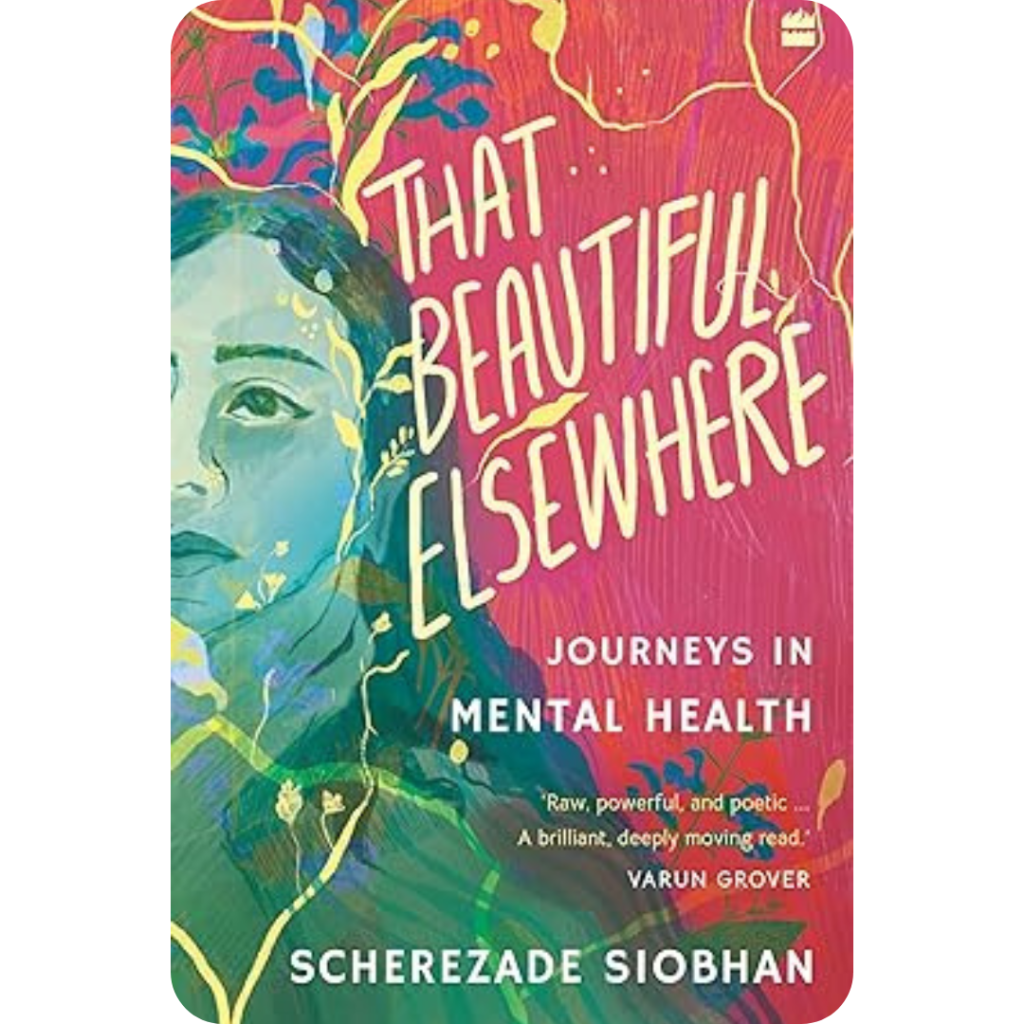
Mithila (MM): Congratulations on publishing this book which is a rare insight into mental health and the grim realities of seeking therapeutic help in India. Can you provide a brief overview of your book and what inspired you to write about mental health in India?
Scherezade (SS): “That Beautiful Elsewhere” is a map rather than a destination. Conversations around and about mental health, especially from practitioners, can easily get trapped in the obvious power differential between someone who “knows” and someone who is in need of “knowing”. Wisdom is good, catharsis is better. In reality, a significant percentage of people who seek therapy with me are trustworthy authorities of their experience. This book – which began as a memoir – is a jigsaw puzzle that the reader is working on with me. Almost an homage to the therapeutic process which, in essence, has to be mutually accepted and collaborative.
This is a unique instance of an unfinished book that derives its value from its very “incompleteness.” Reading is the quickest way to move, to import/export, to travel, to find an “elsewhere” when you are feeling unnerved, suffocated or disconnected with where you are. Or simply when you want to venture and explore. I have felt a kinship to books since I was knee-high so it almost seemed an inescapable truth to parse the trails and encounters I experienced while being on both sides of the fence – as a survivor of psychosocial disorder and then, a practitioner. I distilled stories over several years of practicing as a psychologist. It contains 10 chapters that interweave my own experiences with mental illness on an individual and social level with anecdotes from therapeutic engagements. It is sui generis in shining its spotlight on under-discussed, hushed out or even poorly understood issues that combine our social, scientific and interpersonal interpretations about mental illness, psychological disorders and everything that in between that can’t be neatly defined or categorized.
Can caste-based prejudice be one of the reason behind someone facing certain phobias or intrusive thoughts framed under OCD? Do certain auto-immune disorders have their roots in intergenerational trauma? The book tries to journey through these questions while hoping to meet some answers.
MM: The book is built on a foundation of real-world experience as a psychologist and anonymous stories about the difficult roads travailed by individuals seeking assistance, which makes for an eye and heart opening reading. Give us an insight into the behind-the-scenes experience of sharing these lived experiences with a broad community of readers.
SS: While researching and conceptualizing the book, I was clear about it not projecting a prescriptive approach to mental wellness. In any case, the very term “mental health” is something of a bone of contention for me even though I use it in the absence of a more considerate and nuanced nomenclature. Mostly because its use is often linked to heightened individualization and biomedical dependency in understanding and assisting with psychological disturbances. Of the things we place under this umbrella, several are psychosocial and sociocultural complications, inequities and injustices. Therefore, it was apparent to me that the most responsible and equitable framing about mental wellness in India would have to sit at an intersection between science and storytelling which centered on lived experience. South Asian cultures are very specific crucibles in which certain psychological and psychosocial disruptions occur. They affect us for the rest of our lives till (and if) we find support, community and catharsis. A mental health practitioner is not necessarily the singular authority over someone else’s ordeal, they can – at best – be an observer, a decoder, a helping hand and a caregiver.
It was also important that the stories presented in the book aren’t immaculate or verging on inspiration porn which is my pet peeve when I read books about mental health. These stories reflect lived reality as as form of “ongoing-ness” with sparks of curiosity, joys, struggles and reconciliations. Also, it was incredibly important to adhere to confidentiality clauses and as a result, each story is deeply layered with several myriad experiences woven together to fashion a chapter. No individual’s identity is revealed because there is no specific individual who is telling the story. In that sense, you as a reader can start a chapter and then feel like you are telling this story yourself. Several voices, experiences and journeys are fused to create the road that is “That Beautiful Elsewhere”.
MM: Your book has numerous beautiful references to fiction and non-fiction books, which makes for a well-rounded reading experience. I particularly noticed the mention of tarot, when you mentioned that you use them as a projective test. What are your thoughts about reading tarot cards as a tool for self-discovery?
SS: Ironically, as someone who is half Romani, I discovered tarot because of the cliches about Roma soothsayers. Technically, Romani aren’t tarot readers and it is an annoying stereotype. However, I got interested in tarot also via Carl Jung’s esotericism in the Red Book which I poured over as a teenager. Later, while studying forms of projective testing, I couldn’t help but ruminate over with the similarities between the two. Tarot fascinates me because Rider-Waite whose deck is the most popular in usage was hilariously caustic in his original descriptions and they are nothing like the watered down appeasement a lot of esoteric joo-joo promises these days. I was amused by his snark but also drawn towards the latent existentialism of these readings. In recent years, Jessica Dore’s work around tarot has been particularly informative, especially her inclusion of philosophy, psychoanalysis, critical theory and folklore.
I see tarot as a projective technique. As someone who is drawn to unraveling symbolism, I find it engaging and curious. As for self-discovery, it is important to not get drawn into unnecessary superstitions or fall into the hands of self-elected sophists. If one decides to use tarot in any way, it should be to engage with one’s own psyche, the somewhat submerged unconscious, rather than to expect it to predict the future in some impossibly miraculous way.
MM: What were some surprising or particularly noteworthy findings that you uncovered during your research about mental health in India?
SS: More than surprising, I found it disturbing to note how maladaptive familial dynamics including parentification and enmeshment are so universal within the Indian experience. It doesn’t matter what religion or class or caste background a person comes from, almost 60 percent of therapy cases have some element of excruciating familial harm that thwarts the building up of a healthy individuality in a person. It is painful to bear witness to people leaving their loves, their passions, their preferred career choices because these were not acceptable to their parents and families. That kind of chipping away at a person’s emotional core is a defeating experience and contributes to the formation of a personality disorder or a complicated struggle with chronic depression. I am a huge proponent of family therapy or kin conversations. For a lot of people, any critical change in their condition has to involve the significant people in their lives recognizing the tangled dynamics that contribute to those phases of a panic disorder or prolonged depressive phases.
MM: What changes or improvements do you hope to see in the mental health landscape in India in the coming years, keeping in mind the intersection of gender, caste, sexual orientation, sociocultural and socioeconomic factors?
SS: Championing the grassroots movement around mental health will be the gamechanger in India. While trained professionals in the capacity of psychiatrists, psychologists and psychotherapists are necessary, equally important is the emergence of a community-oriented model of mental healthcare in India where the population is expanding at mach speed. We should perhaps become more interested in adapting models that are being used in the MENASA regions rather than importing everything that happens in the West. For example Zimbabwe’s Dr. Dixon Chibanda’s “Grandmother’s bench” or the Maori practices that are chiseled from local cultures shaping a new form of narrative therapy in New Zealand will suit our needs better.
We need greater outreach for better mental health literacy. We are still so resistant to the idea of a mental health condition that even when a popular and powerful celebrity indicates a hint of it, we see mindless trolling and negation of their lived experience. We can only imagine how it unfolds for those less privileged.
Making mental health outreach messaging available in local languages is an urgent need. Using frames of references that will resonate better with the local audience rather than forcefully transplanting the entirety of practices developed for a North American or European population is critical. Our edifice for mental health care has to rest on three pillars – access, acceptance and affordability.
MM: According to you, what are the possible steps which can be taken to promote active collaboration between mental health professionals and policymakers?
SS: Mental health literacy is the need of the hour in India. We have far too many hard-wired misconceptions about mental health and illness as a country. In rural areas, people continue to misread signs of paranoid schizophrenia as ghostly possession. Psychiatric wards still shackle patients. This can’t change unless they develop some familiarity with the fact that schizophrenia is an illness or a disturbance that exists in quite a few people and can be treated without fear. On the positive side, I have also witnessed immense dedication to mental wellbeing in our rural areas. A farmer would cycle his daughter to a facility every week so could get help for clinical depression. We need to match their efforts in the very least if not supersede them by wide margin. We need to reach out to our most ignored populations who are at the highest risk for mental health disorders in India. Even in urban areas, the general conversations about mental health are punctuated by ignorant assumptions or worse, improper suggestions or advice. I have written in the book about how people kept their meds at my clinic because they were afraid of being “found out” if they took them home. This is very troubling and saddening. In offices, bosses still ridicule social anxiety or depressive episodes as a form of “weakness”. The propagation of myths, misguided tropes and regressive viewpoints about mental illness and psychosocial disorders persist globally but more specifically in the subcontinent.
Mental health professionals are scarce. Most young people who study psychology often veer towards higher-paying corporate jobs instead of actively participating in mental healthcare roles simply because sustenance on meagre salaries is a demanding road to walk.
A chunk of our healthcare budget is allocated towards mental health needs of our population but it is unevenly channeled towards one or two favored institutions. We need more decentralization and humanization in psychiatric and therapeutic systems for a country like India. Policymakers need to factor the overall ecology of socioeconomic factors affecting psychological wellbeing in India. We established Qureist to help construct these types of bridges between those on the frontline and those empowered to construct these policies. Both groups need to actively listen to clients who access mental health help and include their voices in an organized way. Policymakers need to understand that socioeconomic inequities create a domino effect that cascades into several mental health illnesses. If we are actively denying that we have a massive hunger problem for people below poverty line in this country, how do we start to address the depression of a parent who is unable to provide two square meals for their kids? If our public transport system is a can of sardines where getting in or getting out of a bus or a train safely is a form of miracle then what can a psychotherapist offer in real terms to someone with heightened social anxiety about getting to work?
A huge onus also rests on seasoned mental health professionals to collect and speak against the promotion of platitudes or orthodox and inflexible views as normative when people seek out for help. We need to do more than just brand-building and selling courses on social media.
MM: How do you envision your book contributing to the broader conversation around mental health in India?
SS: I hope it helps people recognize that the so-called anomalies or commonly perceived “fault-lines” in psychological functionality aren’t always pathological or clinical but also a different way of processing that need to be accepted rather than erased, written over or dismissed. My book also gently pushes neurodivergence to the center of the conversation from its peripheries. There is a climate of “healing” that is especially prominent on social media where a lot of misinformation and egocentric individualization is passed off as “self-care” when it actually ends up isolating a person. I am a bit averse to the rise of this almost aphoristic therapyspeech that minimizes and reduces the complexities of human experiences. Someone dealing with a mood swing due to a difficult life event isn’t “bipolar”. Someone who wants bit of a time out in a relationship doesn’t need to be tutored about “attachment styles” so much so that they feel overwhelmed about stating a simple need. I am supportive of normalizing therapeutic language but I don’t think it is useful to turn into diagnosticians at the drop of a hat. I am also glad that parts of social media are useful in dismantling the gatekeeping that was prevalent in psychiatry and psychotherapy. However, we have to also regulate the mushrooming of self-proclaimed “experts” who seem to turn every discomfort or disturbance into a disorder for which they can sell people some type of snake-oil salve. We need communities of care, not newer, more “trendy” versions of pathologization.
In the era of endless content production, books could be one of the last remaining rope-bridges to pausing for reflection, conversations and thoughtful interaction. The feeling of being seen, surrounded and accepted is the greatest antidote against any type of turbulence. The book also focuses quite a bit on the perfect storm created by social and cultural factors like patriarchy or casteism that shape the psyche of a person especially in context to certain universally prevalent myths like “stockholm syndrome” or psychiatric classifications like obsessive-compulsive disorders. I hope reading through the chapters that detail how familial gaslighting in South Asian family units is almost normalized as a form of “care” or how the subject of abuse among men is such a taboo even now that it ends up fueling an endless spiral of injuries conducted against self and others will give space for people to break down their own barriers.
There are certain universal narratives about mental health that have gained so much primacy that we don’t factor the inflections that might vary for people of different communities. We are not all cut from the same cloth but at times we are seeking shelter under the same tarpaulin while the rain beats over its uneven spread. Let us give each other some space while we remain close and wait out the storm on certain grey days.
“That Beautiful Elsewhere” stands as a testament to the transformative power of words, inviting readers to embark on a journey that is not only therapeutic but also deeply enriching. I wholeheartedly recommend this book to each and everyone, and you can get your copy (paperback or Kindle) on Amazon.

 Mithila Menezes
Leave a comment